Few places in Chicago carry as much history as Navy Pier. Stretching 3,300 feet into Lake Michigan, it has been a shipping terminal, a military training ground, a university campus, and one of the most visited destinations in the Midwest. Tracing that history means following more than a century of change, rooted in a city that has never been shy about thinking big. Planning a Chicago trip around the pier? Pair it with a meal at Pequod’s Pizza in Lincoln Park, where the deep-dish is as legendary as the lakefront.
The Origins of Navy Pier: Chicago’s Bold Vision for the Lakefront
Chicago’s relationship with its lakefront has always been intentional. City leaders understood early on that Lake Michigan was not just a geographic backdrop but an asset worth protecting and developing for public benefit. That philosophy set the stage for one of the most ambitious infrastructure projects in the city’s history.
The 1909 Burnham Plan and the Case for a Municipal Pier
The story of Navy Pier begins not with a construction crew, but with a blueprint. In 1909, architect and urban planner Daniel Burnham released his Plan of Chicago, a sweeping document that reimagined the entire city and its lakefront. One of its central ideas was opening the shoreline to the public, with piers and green spaces that residents could actually use. The Burnham Plan established the civic principle that the water’s edge belonged to everyone, a principle that still shapes the city today.
The plan called for a series of municipal piers along the shoreline, designed to handle commercial shipping while offering recreational space for Chicago’s growing population. The vision was practical and persuasive enough to get built.
Construction, Opening, and Early Purpose
Construction began in 1914, with architect Charles Sumner Frost overseeing the design, assisted by E.C. Shankland. Navy Pier opened on July 15, 1916, at a cost of approximately $4.5 million, originally called Municipal Pier No. 2. It ranked among the longest piers in the world at the time. The south side held a freight and passenger terminal, while the north side featured an auditorium, a ballroom, and open promenades. Chicago needed better shipping infrastructure, and city planners also wanted to give residents genuine waterfront access. Municipal Pier delivered on both counts, though its civilian identity wouldn’t survive long before the world changed around it.
Why Is It Called Navy Pier? The Military History Behind the Name
Within a few years of opening, the United States was drawn into a global conflict that would reshape the pier’s purpose entirely.
World War I and the U.S. Navy’s Takeover
When the U.S. entered World War I, the military quickly recognized Navy Pier’s strategic value. The U.S. Navy took control and converted it into a training base, using the wide deck space, waterfront access, and large interior facilities for drilling and preparing recruits. The Naval Auxiliary Reserve School trained nearly 4,000 naval officers by the war’s end, and this was the pier’s first real shift from public space to military installation.
After the war, Navy Pier returned to civilian use, but its wartime identity had clearly made an impression. In 1927, the city officially renamed it Navy Pier, honoring the service members who had trained and served there. That name has stuck ever since.
World War II Operations and Naval Training
The pier’s military story did not end with World War I. In August 1941, the Navy closed Navy Pier to the public and converted it into a full-scale training center. The facility could accommodate up to 10,000 service personnel at once and included barracks, a drill hall, a theater, shops, a kitchen, and a hospital. More than 60,000 service members passed through during the war years, and those numbers go a long way toward explaining why the name Navy Pier has always carried real weight.
From Military Base to Campus: Navy Pier’s Postwar Identity (1946–1976)
With the war over, the challenge became figuring out what to do with a massive, underused pier. The city tried several approaches over the following decades, with mixed results. This era of Navy Pier’s history is often overlooked, but it shaped the pier’s trajectory in important ways.
The University of Illinois at Chicago’s Lakefront Campus
One of the more surprising chapters in Navy Pier’s story is its life as a university campus. The Navy returned the pier to the City of Chicago in 1946, and the University of Illinois quickly put it to use housing a branch campus for veterans returning under the GI Bill. Demand for higher education was enormous, and Navy Pier provided a practical solution. Roughly 100,000 students studied there between 1946 and 1965, in repurposed spaces spanning engineering, the liberal arts, and more. That campus eventually helped set the stage for the permanent University of Illinois at Chicago, which opened at a land-based location in 1965.
Trade Shows, Civic Events, and a Pier in Decline
After the university departed, Navy Pier shifted toward trade shows, exhibitions, and civic programming. Without a clear sustained identity, it struggled to stay relevant. Shipping traffic also declined; the St. Lawrence Seaway briefly aided commercial activity before business shifted to modern port facilities elsewhere. The facilities aged without major investment, and by the 1970s, much of the structure had fallen into disrepair. What had once been one of Chicago’s most ambitious waterfront projects now sat largely dormant.
The Redevelopment Era: Rebuilding Navy Pier for the Public
Ready to dine like a local while you’re exploring Chicago? Order from Pequod’s Pizza and fuel up before or after your lakefront adventure.
By the late 1980s, Chicago was ready to reclaim its most underused lakefront asset. A new generation of civic leaders recognized that Navy Pier, with the right investment, could become something genuinely special.
The 1989 Redevelopment Plan and the 1995 Grand Reopening
The Metropolitan Pier and Exposition Authority took charge of Navy Pier’s future in 1989, developing a plan to transform it into a public destination with entertainment, cultural programming, and open recreational space. Renovation work was led by VOA and Benjamin Thompson Associates. On July 12, 1995, Navy Pier officially reopened in its modern form. The grand reopening drew enormous crowds and quickly established the pier as one of the most visited destinations in the Midwest.
Iconic Additions That Shaped the Modern Pier
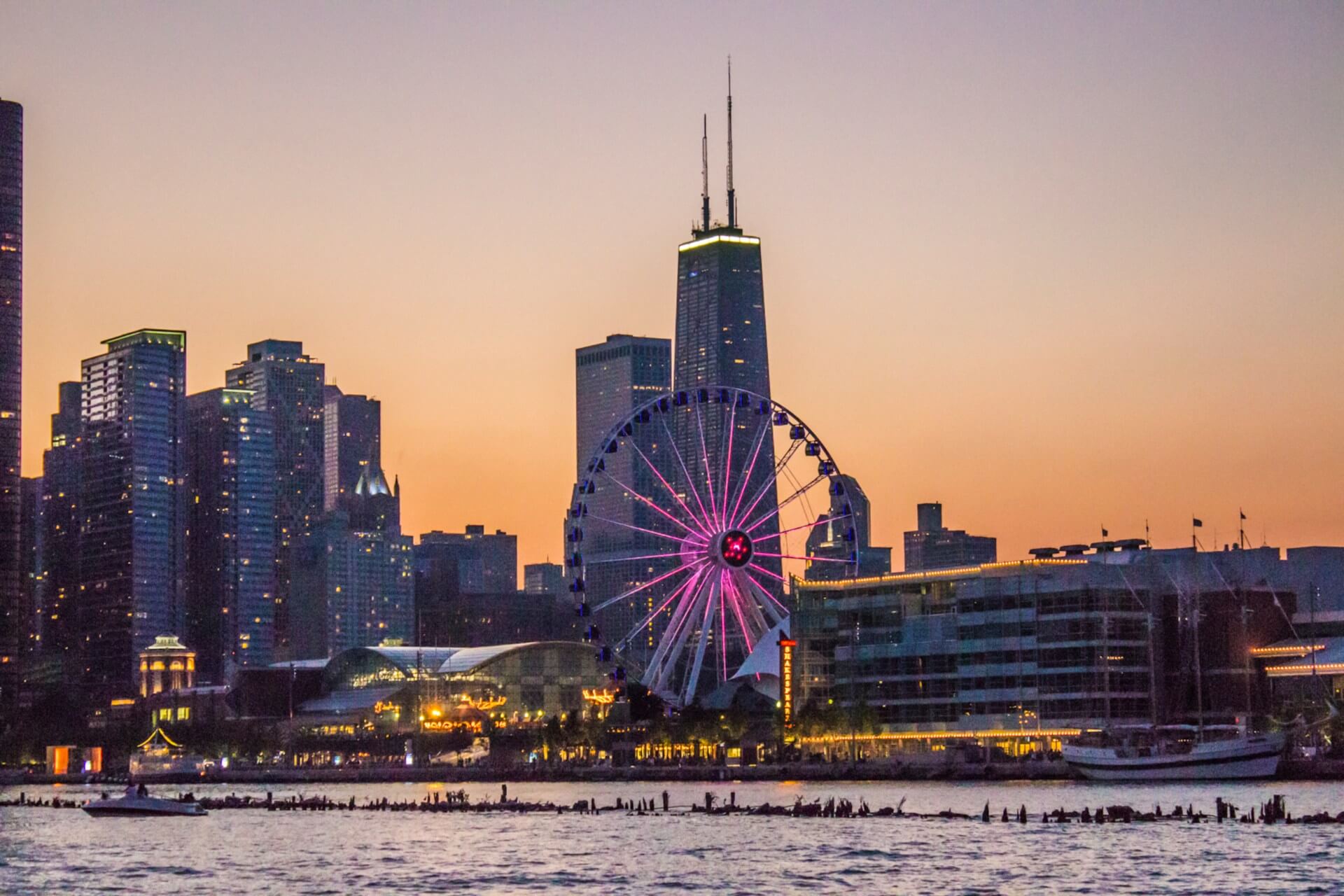
The redeveloped pier introduced a range of attractions that became closely associated with the Navy Pier experience. A Ferris wheel, the Children’s Museum, Crystal Garden, and Festival Hall all helped give the pier broad appeal. Chicago Shakespeare Theater joined in 1999, adding a world-class cultural anchor. These were deliberate choices to make Navy Pier a year-round destination rather than a seasonal novelty, ensuring families, school groups, and solo visitors alike could find something worth the trip.
Navy Pier in the 21st Century: The Centennial Vision and Beyond
In 2011, Navy Pier became a not-for-profit corporation, Navy Pier, Inc., and launched the Centennial Vision, a framework for the pier’s next chapter. The initiative focused on upgrading infrastructure, expanding public green space, improving accessibility, and adding new cultural programming. A taller, more modern Ferris wheel, standing 196 feet tall, was installed as part of the centennial improvements, opening in May 2016.
The centennial celebration in 2016 marked a hundred years since the pier first opened, honoring the full arc of its history from Burnham’s lakefront vision to military service to its life as a college campus. Today, Navy Pier spans more than 50 acres and welcomes nearly 9 million guests annually. Its calendar includes festivals, fireworks displays, art installations, and community events that reflect Chicago’s diversity and energy. The pier sits at 600 East Grand Avenue in the Streeterville neighborhood, easily accessible from downtown and the Magnificent Mile, making it a natural anchor for any Chicago itinerary.
Key Facts About Navy Pier
Navy Pier opened on July 15, 1916, designed by architect Charles Sumner Frost, assisted by E.C. Shankland, at a construction cost of approximately $4.5 million. Originally called Municipal Pier No. 2, its design drew directly from Daniel Burnham’s 1909 Plan of Chicago. The city renamed it Navy Pier in 1927 to honor WWI veterans who had trained there.
During World War I, the Naval Auxiliary Reserve School trained nearly 4,000 naval officers on the pier. In World War II, more than 60,000 service members passed through, with the facility capable of housing up to 10,000 at once. Between 1946 and 1965, roughly 100,000 students studied at the pier as part of the University of Illinois branch campus.
Navy Pier reopened on July 12, 1995, following redevelopment by VOA and Benjamin Thompson Associates. Chicago Shakespeare Theater joined in 1999. In 2011, Navy Pier became a not-for-profit corporation under the name Navy Pier, Inc. Today the pier covers more than 50 acres and draws nearly 9 million visitors each year.
Make It a Full Chicago Day with Pequod’s Pizza
After walking the pier and taking in a century of Chicago history, there’s only one way to close out the day: deep-dish pizza. Pequod’s Pizza has been a Chicago institution for more than 50 years, known for its signature caramelized cheese crust, formed when cheese bakes directly against the sides of the pan and crisps into a deeply flavorful edge unlike anything else in the city. Recognized by Bon Appétit, Yelp’s 100 Best Pizzas in America, and USA TODAY, Pequod’s is the kind of place locals swear by and visitors never forget. Lakefront history and a legendary deep-dish crust: that’s a proper Chicago day.
Photo by Gautam Krishnan on Unsplash