
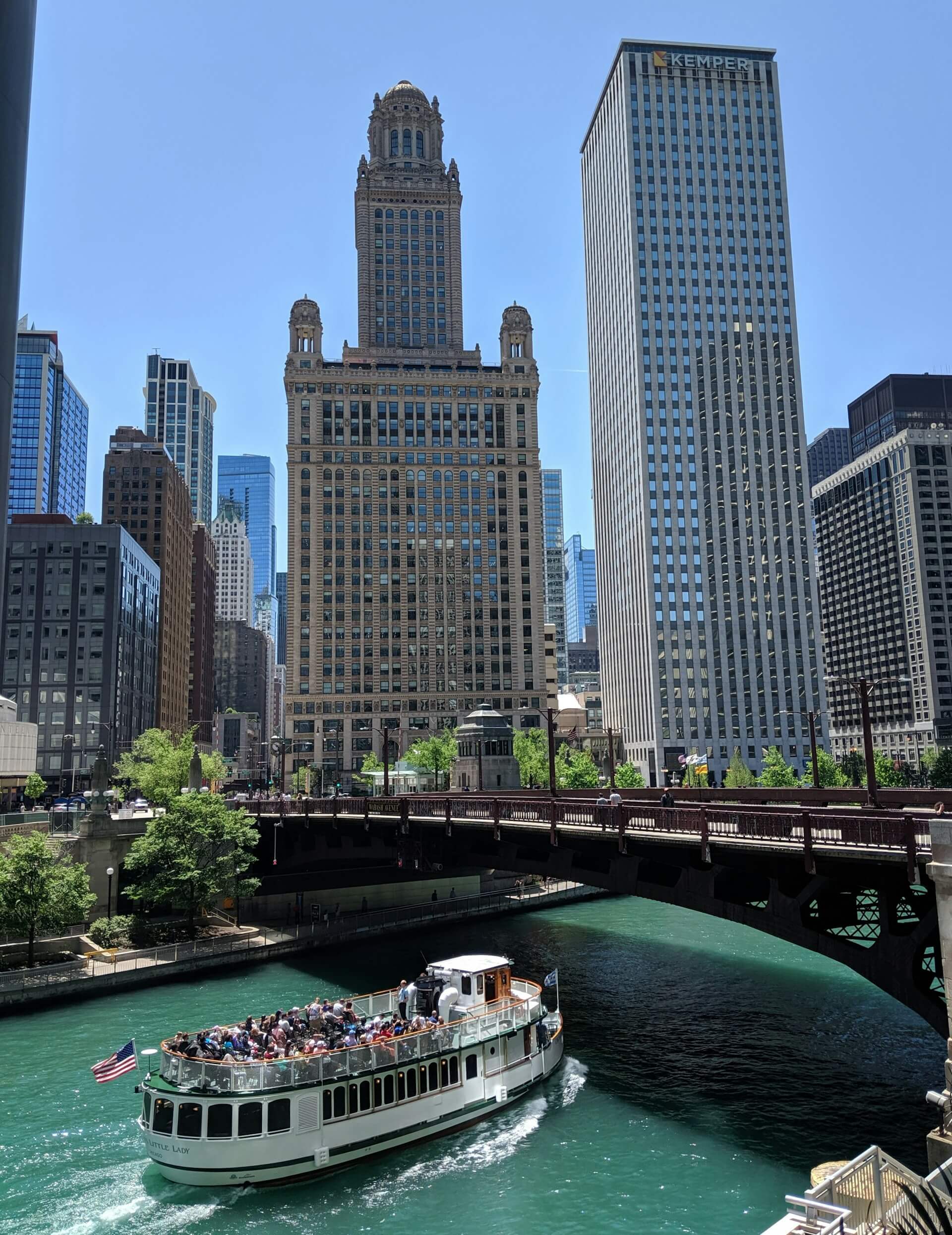
Few cities have ever done anything quite as audacious as reversing the flow of a river. Chicago did exactly that, and it changed the course of urban history. The Chicago River reversal stands as one of the most remarkable engineering feats ever attempted in North America, and understanding why it happened tells you a lot about the city itself: ambitious, practical, and unwilling to accept the unacceptable.
The Day Chicago Flipped Its River
In the early hours of January 1, 1900, workers quietly blasted open the last dirt barrier separating the Chicago River from a newly built canal. The act was deliberate and urgent. Engineers had received word that a lawsuit might be filed to stop the project, so the decision was made to move overnight rather than risk a court injunction. By the time most Chicagoans woke to the new year, the river had already begun flowing in the opposite direction. The reversal was officially completed the following day, January 2, 1900.
It wasn’t exactly a dramatic finale to one of the most ambitious public works projects in American history. But that quiet shift in current represented the culmination of decades of crisis, political pressure, and engineering ambition. Chicago had grown at a pace that outstripped its infrastructure, and by the close of the 19th century, the consequences were deadly. The city that had rebuilt itself after the Great Fire of 1871 was now fighting a quieter, slower enemy: its own waste.
The Public Health Crisis Behind the Chicago River Reversal
A City Drinking Its Own Waste
To understand why the Chicago River reversed direction, you first have to understand the geography. Lake Michigan sits to the east of Chicago and has historically served as the city’s primary source of drinking water. The Chicago River, running through the heart of the city, originally drained into the lake. As Chicago’s population exploded in the mid-to-late 1800s, untreated sewage and industrial waste poured into the river without pause.
The problem was both obvious and devastating. Everything the city discarded ended up flowing eastward into Lake Michigan, the same body of water supplying Chicago’s drinking water. During heavy rains, the contamination worsened sharply, flushing enormous quantities of waste directly toward the water intake cribs positioned offshore.
Typhoid, Cholera, and the Demand for Change
The health consequences were catastrophic. Typhoid fever and cholera tore through Chicago’s neighborhoods with terrifying regularity. These diseases thrived in contaminated water and spread quickly through a population that had no way of knowing how compromised their drinking supply had become. Mortality rates climbed, and the link between the dirty river and the illnesses killing residents became impossible to ignore.
In 1885, an extreme weather event overwhelmed the city’s already strained water intake system, dramatically accelerating public concern. The episode made clear that the existing arrangement couldn’t hold. Citizens demanded action, and political leaders who had once moved slowly on the issue found themselves with no room left to delay.
In 1887, the Illinois General Assembly formally decided that the river’s flow must be reversed. Two years later, in 1889, the state created the Chicago Sanitary District (now known as the Metropolitan Water Reclamation District) to oversee the project. The question was no longer whether something needed to be done. The question was how.
Why Reversing the River Was the Chosen Solution
Several proposals circulated in the years leading up to the final decision, but reversing the river’s flow emerged as the most comprehensive answer. Rather than treating symptoms, the reversal aimed to eliminate the source of contamination by redirecting the river away from Lake Michigan and toward the Illinois River system to the southwest. Water would follow a new path: Chicago River to the Des Plaines River, then to the Illinois River, and ultimately to the Mississippi River.
This wasn’t just about fixing a sewage problem. It reflected a fundamentally new way of thinking about urban water management. By changing the direction of flow, city planners could protect Lake Michigan as a clean drinking source while channeling waste somewhere it could be diluted and eventually processed.
The plan also served a dual purpose: the new canal would support commercial shipping, connecting Chicago to the Mississippi River system and reinforcing the city’s position as a national trade hub. Public health and economic ambition, addressed in a single project.
How Engineers Pulled Off the Chicago River Reversal
Constructing the Chicago Sanitary and Ship Canal
The engineering challenge was staggering. Workers needed to construct the Chicago Sanitary and Ship Canal, a 28-mile waterway connecting the Chicago River to the Des Plaines River. At the time, it ranked among the largest earth-moving projects anywhere in the world, requiring workers to dig through dense glacial moraine and solid bedrock across the entire route.
The project began in 1892 and employed thousands of workers using steam shovels and dynamite. The engineering techniques developed during construction became known collectively as the “Chicago School of Earth Moving,” a body of practice that influenced large-scale infrastructure projects for decades.
Engineers had to design the canal so that gravity would naturally pull water southwestward, which required precise elevation calculations with essentially no margin for error. A miscalculation in grade could mean the reversal wouldn’t hold, or that floodwaters would overwhelm surrounding communities.
January 2, 1900: The Moment the Current Changed
Following the overnight blasting on January 1, workers opened the controlling works at Kedzie Avenue the next day and the water began to move. The Chicago River flow reversal happened not with great ceremony but with a quiet, almost understated shift in current. Water that had flowed toward Lake Michigan for centuries started moving in the opposite direction.
The significance wasn’t lost on those who witnessed it. The reversal represented one of the rare moments when human ingenuity genuinely redirected nature’s design. In 1999, the American Society of Civil Engineers named the Chicago Sanitary and Ship Canal a Civil Engineering Monument of the Millennium, placing it alongside some of the most consequential infrastructure ever built.
The Controversy and Legal Battles That Followed
Chicago’s engineering triumph was not universally celebrated. Communities downstream, particularly in Missouri and the broader Mississippi River watershed, immediately raised alarms. If Chicago was redirecting its sewage southward, who would bear the consequences? Missouri filed suit against Illinois, arguing that Chicago was simply moving its pollution problem rather than solving it. The case eventually reached the U.S. Supreme Court, making the history of the Chicago River reversal as much a legal story as an engineering one.
Water rights disputes were fierce. Downstream states worried about the volume of water being diverted from Lake Michigan and about the quality of what was flowing into the Mississippi River system. These challenges took years to resolve and established important precedents for how cities and states would negotiate over shared water resources. The controversy revealed something worth remembering: transformative infrastructure decisions rarely affect only the people who make them.
The objections from Missouri and other downstream states weren’t unreasonable. They were raising genuine questions about the distribution of environmental costs, questions that had no clean answers in 1900 and that urban planners and water managers are still grappling with today.
What the Reversal Achieved for Chicago and Its People
The results for Chicago were profound. Waterborne disease rates dropped measurably in the years following the reversal. Research has estimated that the reversal reduced overall mortality by approximately 4 percent in 1900 alone, roughly 985 lives, with the most concentrated effects in summer months, consistent with a reduction in waterborne illness. Typhoid and cholera, which had claimed thousands of lives, became far less prevalent as Lake Michigan was no longer being used as an open sewer.
The Chicago Sanitary and Ship Canal also delivered on its commercial promise. Barges and freight vessels used the new waterway to connect the city to the broader river network, reinforcing Chicago’s role as a transportation hub. Beginning in 1929, a series of treatment plants and infrastructure projects were constructed to treat the region’s wastewater before release, building on the reversal’s foundation and steadily improving outcomes for waterways throughout the region.
Beyond the immediate benefits, the project laid the groundwork for modern wastewater treatment practices. Engineers and public health officials across the country studied what Chicago had done and applied those lessons to their own growing cities. In many ways, the reversal helped define how 20th-century America would approach urban sanitation.
The Chicago River’s Lasting Legacy
Today, the Chicago River still flows in its reversed direction, carrying water away from Lake Michigan toward the Illinois and Mississippi river systems. What once seemed like a radical, even reckless idea is now simply the way things are.
An Ecological Corridor With Unintended Consequences
The reversal created more than a new water route. By connecting the Great Lakes basin to the Mississippi River watershed through an open channel, it established a continuous corridor for aquatic life, including invasive species.
That corridor remains an active ecological concern today. Fish and other organisms that would never have encountered each other under natural conditions can now potentially move between two of North America’s most significant water systems, and ongoing debates about how to manage or close that pathway have no easy resolution.
A River Revived
The river has continued to evolve in other ways. Ongoing environmental restoration efforts have improved water quality significantly over the past few decades. What was once dismissed as a lifeless industrial waterway has become a public asset supporting ecosystems, recreation, and economic development.
The river today draws kayakers, architecture tour boats, and seasonal festivals, and has become a destination in its own right, a genuine transformation that would have been difficult to imagine during the worst years of the 19th-century contamination crisis.
That willingness to tackle seemingly impossible problems, to commit resources and ingenuity to a challenge others might have accepted as permanent, remains part of Chicago’s civic identity. The reversed river is its most literal expression.
Visit a Chicago Icon — Reserve Your Table at Pequod’s Pizza
A Chicago Institution Worth Experiencing
Chicago’s history of bold, meaningful decisions extends well beyond its engineering achievements. The same city that reversed a river has also built a food culture that draws visitors from around the world. Deep dish pizza is as much a part of the Chicago story as the river itself, and few places represent that tradition more authentically than Pequod’s Pizza.
Two Locations, One Legacy
Pequod’s has been serving Chicago since 1970 and has earned a devoted following for its deep dish pizza. Whether you’re exploring the city’s remarkable history or simply looking for a place to settle in after a long day, both locations offer a welcoming experience.
The Lincoln Park location sits at 2207 N. Clybourn Ave in Chicago, while the Morton Grove location serves the northwest suburbs. Reservations receive priority seating over walk-ins, so planning ahead is worth it. After a day spent thinking about rivers and the people who reversed them, a table at Pequod’s sounds exactly right.
Photo by Solstice Hannan on Unsplash