Throughout the years, the Chicago Cubs’ logo has seen quite a bit of change. With more than a dozen redesigns (and a few different names), the history behind today’s well-known emblem is unlike any other. So pull up a chair and get ready to dive into the fascinating evolution of one of the oldest baseball teams in the National League.
The Origin Story (1870-1902)
Long before the construction of Wrigley Field began in 1914, the Chicago Cubs went by a different name. The Chicago White Stockings were founded in 1870, and the team would go through several rebrandings before finally becoming the Cubbies we know and love today. In the 1890s, they were known as the Chicago Colts, but this name was quickly replaced when Adrian “Cap” Anson passed away.
Anson served as the team’s legendary captain, who led them to six National League pennant wins. He was also their manager and part-owner, which more than justified their next name change. From 1898 to 1902, they were known as the Chicago Orphans. The name “Cubs” actually didn’t appear in print until 1903.
At that time, it was just a nickname used to highlight that the most experienced players were no longer on the team, leaving only a group of very young athletes. Nevertheless, the nickname stuck. In 1907, they officially rebranded as the Chicago Cubs, and in 1908, they would go on to win their first World Series.
Early Cubs Logos (1903-1926)
In the beginning, the Cubs’ “C” logo was a simple, no-frills design. Between 1903 and 1907, it transformed from a handwritten gothic letter to a traditional serif typeface and finally a wishbone-style font. In 1908, the Cubs finally got a mascot. This logo featured a silhouette of a bear holding a baseball bat inside of a bold, sans-serif letter C. Over the next few years, the team played with the color scheme, changing the bear’s brown fur to a dark navy blue for a monotone color scheme.
The next big change wouldn’t come until 1916. In this edition, the bear went from standing on his hind legs to walking on all fours inside of a bright red C. This new color palette and more ferocious-looking mascot gave the team a more masculine appearance, but it didn’t last long. In 1917, a simplified logo emerged that simply featured the words “Chicago Cubs” in a blue serif typeface. Another short-lived logo made an appearance in 1918, featuring a gold square “C” that encapsulated the letters “UBS,” but by 1919, the red and blue wishbone “C” made its return.
Iconic Elements and a Classic Design (1927-1956)
The Chicago Cubs logo varied significantly during these years, but it still maintained several iconic elements. The 1927 version replaced the letters inside the red and blue wishbone “C” with the old silhouette of a blue bear carrying a baseball bat. 10 years later, the bear would be replaced by “UBS” once again, but this time the letter “C” appeared in a simple sans-serif typeface that was bolder than ever.
Perhaps the most drastic change came in 1941 with the brown Chicago Cubs bear logo. Without any letters or other branding elements, this line drawing of an angry cub was still a memorable design.
The Modern Iconic Logo (1957-1978)
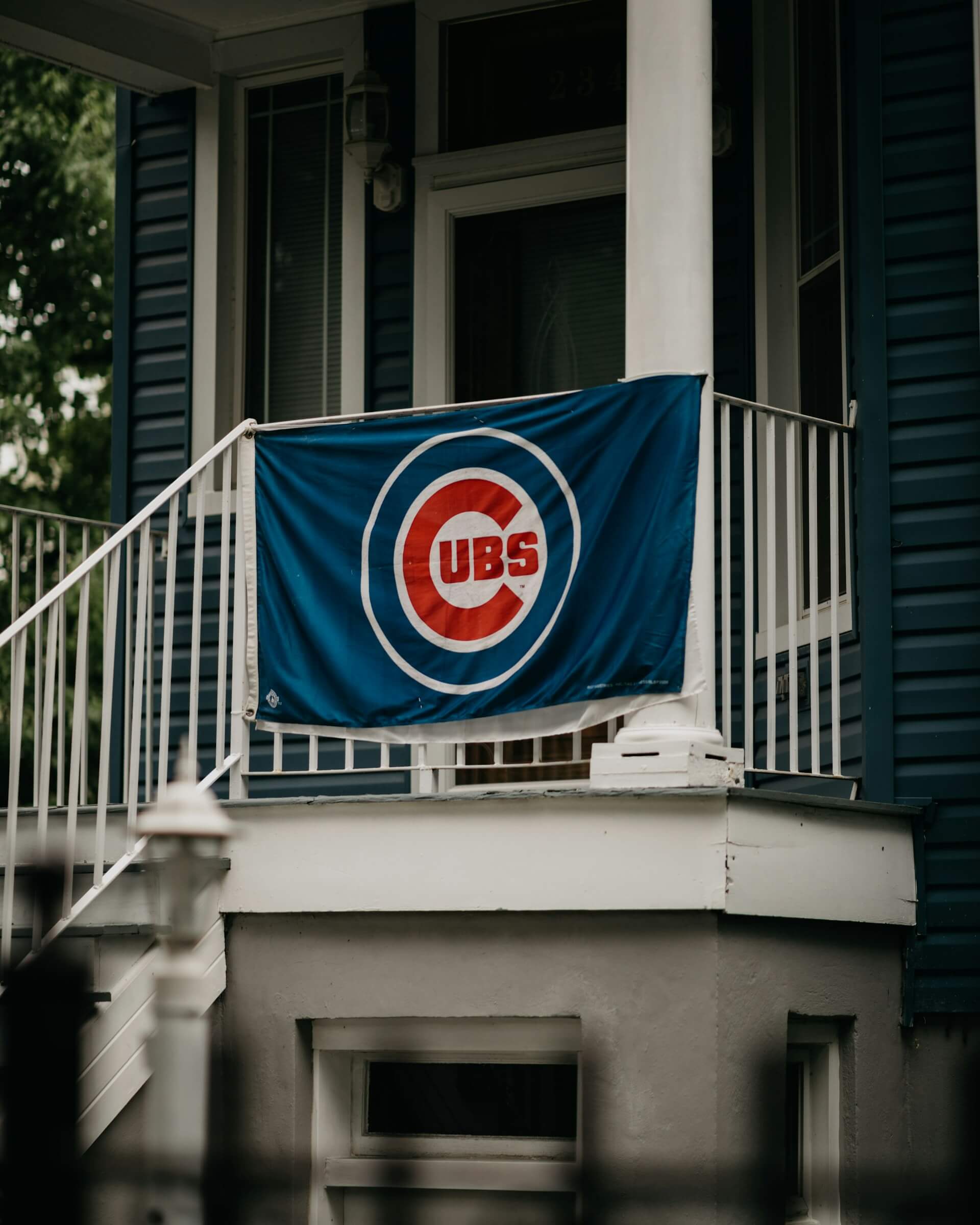
In 1957, the Cubs said goodbye to the bear for good. This new logo paved the way for the version we have today. The design places a bold red “C” and the sans-serif letters “UBS” inside a thin blue circle. The red, white, and blue colors, combined with clean lines, feel well-balanced and professional. Even though we love looking back at all the Cubs’ logos through the years, it’s no wonder that this is the version that stuck.
Of course, some fans still miss the iconic bear mascot. That’s why in 1972 the team introduced an alternate badge. This secondary logo gets a refresh every few years, but it always features the beloved bear cub front and center.
The Contemporary Cubs Logo (1979-Present)
The Cubs’ logo received one more round of edits in 1979. While today’s version is similar to the one introduced in 1957, all of the elements are noticeably bolder. The “UBS” letters also take up more space than before, but the design remains simple and instantly recognizable. For nearly 50 years, this has been the version fans have sported as the Chicago Cubs’ official logo.
The Complete Cubs Logo Timeline
There certainly have been a number of Chicago Cubs historical logos throughout the years, and they’ve varied significantly. Let’s recap with a quick timeline of the most iconic designs.
- 1903: The initial logo is an ornate Gothic letter “C” with thick lines in a dark blue color.
- 1906: The “C” appears in a simplified serif font with clean, round lines.
- 1907: The “C” gets another facelift with a wishbone-style font and a slightly lighter shade of blue.
- 1908: The iconic bear mascot makes an appearance holding a baseball bat inside a bold, sans-serif letter “C.”
- 1911: The Cubs adopt a monotone approach, changing the color of the bear from brown to navy blue.
- 1916: The entire logo is redrawn to feature a bear walking on all four legs inside of a red wishbone “C” with a blue outline.
- 1917: The mascot imagery completely disappears, and the logo simply reads “Chicago Cubs” in all uppercase letters.
- 1918: The Cubs release a boxy new logo, with a gold, rectangular letter “C” encompassing the letters “UBS.”
- 1919: The red wishbone “C” makes a comeback, surrounding the letters “UBS” once again.
- 1927: The original bear holding a bat makes a reappearance, replacing the letters “UBS” inside the red wishbone “C.”
- 1937: The wishbone lettering is replaced with a bold sans-serif font.
- 1941: The logo goes through one of its biggest transformations, simply depicting the face of an angry brown bear cub.
- 1957: The team reverts to its 1937 design but adds a thin blue circle to the outside of the logo.
- 1979: The Chicago Cubs’ official logo finally takes shape with bolder lines and bigger letters.
Watch Cubs Games at Pequod’s in Chicago
Now that you know all about the history of the Cubs’ logo, why don’t you join us for a game? Share your new knowledge with other sports fans at our Chicago restaurant on Clybourn Avenue. Prefer to watch the Cubs from the comfort of your own home? No worries. Order one of Pequod’s famous frozen pizzas so you can kick back and relax.
Photo by Luigi Ritchie on Unsplash