
Chicago’s skyline tells the story of American architectural ambition. From the ashes of the Great Chicago Fire of 1871 emerged a city determined to build upward, pioneering the steel-frame construction that would redefine urban landscapes worldwide.
Today, the famous skyscrapers in Chicago represent more than vertical real estate. They’re living monuments to engineering breakthroughs, design innovation, and the spirit of a city that refused to be held down. Whether you’re drawn to observation decks that test your nerve or historic towers embedded with fragments of global landmarks, Chicago’s iconic buildings offer experiences you won’t find anywhere else.
Why Chicago’s Skyline Defines American Architecture
Chicago earned its reputation as the birthplace of the modern skyscraper. After the 1871 fire destroyed much of the city, architects saw opportunity in catastrophe. The need to rebuild quickly and maximize limited land pushed innovators to experiment with steel-frame construction, replacing heavy masonry with lighter, stronger frameworks that could support unprecedented heights.
The skyline you see today spans over a century of design evolution. Neo-Gothic spires from the 1920s stand alongside contemporary glass towers with undulating facades. Each era left its signature: the bundled tube structures of the 1970s, the postmodern curves of the 2000s, and the sustainable designs reshaping today’s cityscape. This blend of historic and contemporary architecture creates a visual timeline that architecture enthusiasts travel thousands of miles to study.
What makes Chicago’s skyline uniquely compelling? These structures perform double duty. They’re functional spaces housing offices, residences, and hotels, yet they also serve as public attractions with observation decks and interactive experiences. The city’s greatest architecture isn’t locked behind velvet ropes. It invites you to step onto glass ledges, tilt over city streets, and see four states from a single vantage point.
Willis Tower
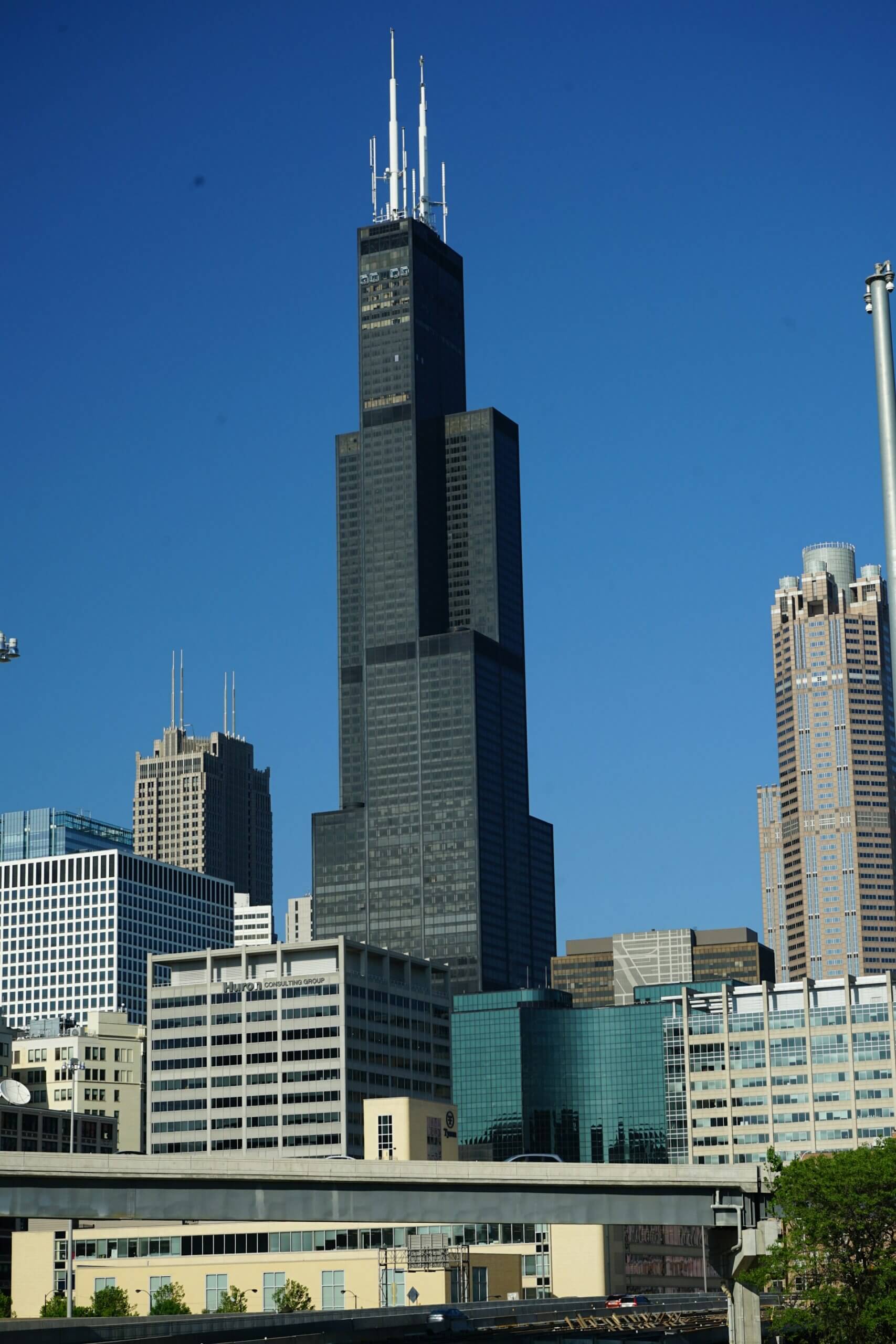
Standing at 1,451 feet to its antenna tip, Willis Tower remains Chicago’s tallest building and an engineering marvel that dominated skylines for a quarter-century after its 1973 completion. Architect Bruce Graham and structural engineer Fazlur Rahman Khan developed something revolutionary here: the bundled tube design. They clustered nine square tubes of varying heights to create stability against wind forces while maximizing the building’s 4.5 million square feet of space. This innovation allowed Willis Tower to rise higher than any structure before it without requiring massive interior columns.
The tower houses more than 100 companies across its floors, but most visitors come for what’s at the top. Skydeck Chicago sits at 1,353 feet on the 103rd floor, drawing 1.7 million visitors annually who want to experience one of America’s highest observation points. On clear days, the visibility extends up to 50 miles across four states: Illinois, Indiana, Michigan, and Wisconsin.
Skydeck Chicago and The Ledge Experience
The observation deck offers more than expansive views. The Ledge, introduced in 2009, redefined what observation experiences could be. Four glass boxes extend 4.3 feet from the building’s facade, constructed with three layers of half-inch laminated glass capable of supporting 10,000 pounds. Visitors get 90 seconds per balcony to stand suspended above Chicago’s streets. It’s that stomach-dropping sensation of floating in mid-air that people either love or immediately regret.
Interactive exhibits throughout Skydeck tell Chicago’s architectural story, explaining how innovations born in this city influenced skyscraper development globally. Visit during weekday mornings to avoid peak crowds, or arrive at sunset when the city transitions from daylight to its glittering night display.
John Hancock Center (875 North Michigan Avenue)
Rising 1,127 feet across 100 stories, the John Hancock Center showcases the braced-tube structural system through its distinctive exterior X-bracing. Completed in 1969, these massive black steel X-patterns aren’t just aesthetic choices. They’re load-bearing elements that transfer wind forces down the building while allowing for column-free interior spaces. This design solution gave the building both its structural integrity and its instantly recognizable silhouette.
The tower combines residential, commercial, and retail uses, but its observation deck makes it a standout Chicago destination. Located on the Magnificent Mile, the building anchors one of the city’s premier shopping and dining districts. You can easily combine architectural tourism with other activities.
360 CHICAGO and TILT Experience
The view from 360 CHICAGO on the 94th floor offers a different perspective than Willis Tower, positioned further north along Lake Michigan’s shoreline. The TILT experience takes observation decks to new heights (or more accurately, new angles). Enclosed glass-and-steel platforms slowly tilt outward to a 30-degree angle, allowing visitors to lean over Michigan Avenue while secured in place. Unlike The Ledge’s open-air feel, TILT provides a controlled descent that combines safety with genuine exhilaration.
The observation deck includes CloudBar, where you can enjoy drinks while taking in views that stretch across the city and lake. Interactive screens throughout the space provide information about visible landmarks, helping visitors identify what they’re actually seeing. The northern vantage point offers particularly stunning views of Navy Pier, Oak Street Beach, and the geometric patterns of Chicago’s street grid extending toward the horizon.
Trump International Hotel & Tower
At 1,388 feet across 98 stories, Trump International Hotel & Tower claimed its place as Chicago’s second-tallest structure when completed in 2009. Architect Adrian Smith designed the building with a stepped facade featuring curved stainless steel panels and a glass curtain wall system that reflects the Chicago River and surrounding skyline. The building’s profile creates a distinctive setback design that adds visual interest from various angles around the city.
The mixed-use tower combines luxury hotel rooms, residential condominiums, restaurants, and retail spaces. Its riverside location on the Chicago River’s main branch positions it prominently on architectural boat tours, where guides explain how its contemporary design contrasts with and complements the historic architecture surrounding it. The building’s reflective surfaces capture changing light throughout the day, making it particularly photogenic during golden hour when the glass facade glows with warm tones.
Tribune Tower and Wrigley Building
These two iconic buildings face each other across Michigan Avenue, representing 1920s architecture at its most theatrical. Tribune Tower, completed in 1925, rises 463 feet in Neo-Gothic style with flying buttresses, pointed arches, and intricate stone carvings that recall European cathedrals. Its most unusual feature remains embedded in the exterior walls: stones collected from famous sites worldwide, including Westminster Abbey, the Parthenon, and the Great Wall of China. Tribune journalists brought back these fragments as souvenirs, creating a building that literally incorporates pieces of global history.
Across the avenue, the Wrigley Building’s white terracotta facade reaches 399 feet, crowned by a clock tower that’s illuminated nightly. Completed in 1924 as headquarters for the chewing gum empire, its French Renaissance-inspired design features ornamental details that catch and reflect light beautifully. The building’s two sections connect via enclosed walkways at multiple levels.
Together, these structures anchor the Michigan Avenue Bridge area and showcase Chicago’s historic architecture that predates the modernist movement. They remind visitors that the city’s architectural innovation wasn’t limited to engineering height but also embraced decorative artistry and historical references that created landmarks meant to inspire.
Aqua Tower
Aqua Tower introduced a fluid aesthetic to Chicago’s predominantly angular skyline when completed in 2009. Rising 870 feet across 82 stories, the building’s undulating concrete balcony slabs create a wave-like appearance that changes depending on viewing angle and light conditions. Architect Jeanne Gang designed these varied balconies to maximize views while providing wind protection and privacy between residential units. It proves that functional requirements can drive stunning visual innovation.
The tower exemplifies sustainable design principles, incorporating energy-efficient technologies and green building practices that earned multiple environmental awards. Its mixed-use program includes residential units, a hotel, and commercial spaces, all wrapped in the signature wavelike facade. From certain angles, Aqua Tower appears to ripple like water, an effect particularly striking when viewed from Lake Michigan or the Chicago Riverwalk. The building demonstrates that famous skyscrapers in Chicago aren’t all about achieving record heights. Sometimes it’s about reimagining what tall buildings can look like.
How to Experience Chicago’s Famous Skyline
Experiencing Chicago’s skyscrapers extends beyond visiting observation decks. The city’s layout creates numerous opportunities to appreciate these structures from different perspectives, each revealing new details about their design and place in the urban fabric. Planning your approach thoughtfully transforms casual sightseeing into genuine architectural understanding.
Start at street level, where you can appreciate details like the Tribune Tower’s stone fragments or the John Hancock Center’s massive X-bracing up close. Walk the Chicago Riverwalk to see how buildings interact with the waterway. Visit Millennium Park for classic skyline photos with Cloud Gate in the foreground. For sunset views, head to the Adler Planetarium’s lakefront location, where you can photograph the entire skyline silhouetted against colorful skies.
Timing matters significantly. Morning light illuminates east-facing facades beautifully, while late afternoon bathes west-facing buildings in warm golden tones. Night transforms everything as buildings light up, creating a glittering display best viewed from elevated positions or from a boat on the river or lake.
Architectural River Cruises and Photography Spots
Architectural river cruises offer unmatched perspectives on Chicago’s buildings. These cruises glide past structures from water level, where tour guides trained by the Chicago Architecture Foundation explain each building’s history, design innovations, and relationship to the city’s development. These 90-minute cruises cover the main branch and both forks of the Chicago River, passing more than 50 notable buildings while explaining concepts like the bundled tube system or how setback zoning influenced building shapes.
Prime photography spots include the Michigan Avenue Bridge for capturing the Wrigley Building and Tribune Tower together. The Riverwalk near the Vietnam Veterans Memorial Plaza works great for low-angle shots of multiple towers. For wide skyline views, try the Lake Michigan shoreline near North Avenue Beach. Serious photographers should explore sunrise sessions at Northerly Island or the Museum Campus, where you can capture the skyline reflected in the harbor with dramatic building silhouettes.
Budget-friendly options? Ride the CTA Brown Line between Merchandise Mart and Chicago stops for elevated train views past downtown towers. During summer months, take the free Chicago Water Taxi for quick river glimpses between stops.
Fuel Your Chicago Adventure at Pequod’s Pizza
After hours spent exploring Chicago’s architectural treasures, refuel at Pequod’s Pizza, a Chicago institution that’s earned legendary status since 1971. Famous for its pan-style deep-dish pizza featuring a signature caramelized cheese crust, Pequod’s delivers the authentic Chicago culinary experience that pairs perfectly with a day spent discovering the city’s vertical achievements.
Photo by Mike Balbus on Unsplash