Chicago is a city that loves its baseball, but it has never been able to agree on which baseball. For over a century, the Cubs White Sox rivalry has divided households and bar stools across the city, running through neighborhoods like a fault line. It carries a loyalty that gets handed down through generations, often before a kid is old enough to understand the standings. No other city hosts this kind of internal baseball war quite like Chicago, and understanding why means going back to where it all started.
Origins of the Cubs-White Sox Rivalry
The Cubs and White Sox have coexisted in Chicago longer than most modern sports rivalries have existed. Sharing a city was never going to be simple, and it wasn’t.
How Two Teams Sharing One City Became Rivals
The White Sox entered the American League in 1901 when Charles Comiskey established the franchise on Chicago’s South Side. The Cubs, already a National League fixture, called the North Side home. Wrigley Field sits in Lakeview; Guaranteed Rate Field is on the South Side, roughly nine miles away. The physical distance is short. The cultural distance has always felt much wider.
Cubs fans have long carried a more suburban, middle-class reputation, while White Sox supporters are rooted in the South Side’s industrial communities and wear a working-class identity proudly. Whether those characterizations are entirely fair is another argument, but they’re identities that generations of fans have genuinely owned. When people debate Cubs fans versus White Sox fans, they’re often really debating two versions of Chicago itself.
Why the Crosstown Classic Stands Apart from Other MLB Rivalries
Most MLB rivalries are built on geography or postseason clashes. The Cubs White Sox rivalry operates differently. These two teams almost never meet in the playoffs, which means the stakes during their regular-season matchups, the Crosstown Classic, carry a uniquely personal weight. There’s no championship belt to fight over. The bragging rights are entirely local, which somehow makes them more meaningful.
The rivalry also benefits from a compressed media market. Chicago columnists and radio hosts cover both teams simultaneously, and when the Cubs and White Sox play each other, the city’s sports conversation narrows to one series.
A History of the Cubs vs. White Sox: Era by Era
The Cubs White Sox history stretches back well before interleague play was a concept. Tracing the full timeline means following how a loosely structured bragging-rights competition gradually became one of baseball’s most anticipated regular-season events.
The Chicago City Series (1903–1942)
Before interleague play existed, the two clubs met in the Chicago City Series, a formal set of exhibition matchups arranged by White Sox owner Charles Comiskey and Cubs owner James A. Hart. The series opened in 1903 with an 11–0 Cubs victory and ran through 1942. Over 161 games, the White Sox held the upper hand, going 95–62 with 4 ties and winning 18 of 25 series to the Cubs’ 6, with one series ending in a tie.
The most significant meeting of that era came in the 1906 World Series, the only postseason meeting between the two franchises. The White Sox, famously called the “Hitless Wonders,” defeated the Cubs four games to two, upsetting a Cubs team that had won 116 games that season. It remains the only time both Chicago teams have met in October.
1997–2002: The Crosstown Classic Becomes a Regular-Season Fixture
When MLB introduced interleague play in 1997, the Cubs and White Sox finally had an official regular-season stage. The first formal series generated enormous buzz. Every pitch between these teams suddenly carried standings implications, and the Crosstown Classic became a real event on the MLB calendar, not just a cultural tradition.
Through the late 1990s and into the early 2000s, the series became one of the most anticipated stretches of the Chicago baseball calendar. Tickets were harder to get. Bars filled up earlier. The city’s sports conversation narrowed to one question: who’s winning this series?
2000s–2010s: Peak Passion, Championships, and Shifting Momentum
The decade between 2005 and 2016 was the most emotionally turbulent stretch in the rivalry’s history. Both franchises experienced championship glory for the first time in decades, and each title fundamentally shifted the rivalry’s psychological balance.
Cubs vs. White Sox All-Time Series Record
The Cubs White Sox all-time record reflects how competitive this series has been. The two teams have only met in the regular season since interleague play began in 1997, and the ledger has stayed remarkably balanced ever since. Every win in a Crosstown Classic matters precisely because the series is close enough to tip with a single good weekend of baseball.
| Category | Cubs | White Sox |
|---|---|---|
| All-time regular-season series (as of 2026) | 78 wins | 77 wins |
The Cubs hold a razor-thin 78–77 edge in the all-time regular-season series, a margin of a single game across nearly three decades of crosstown meetings. The only postseason matchup came in the 1906 World Series, which the White Sox won; counting that, the overall head-to-head tilts to the White Sox 81–80. Either way, the series is among the most closely contested geographic rivalries in baseball, which is exactly what makes each weekend of the Crosstown Classic worth watching.
Defining Moments That Shaped the Cubs-White Sox Rivalry
Rivalries need defining moments to stay alive, and the Crosstown Classic has no shortage of them. Two in particular stand above the rest as events that reshaped how both fan bases understood themselves and each other.
2005: The White Sox World Series Title Stings the North Side
The 2005 White Sox World Series run was one of the most dominant championship performances in modern baseball history. The Sox swept the Houston Astros and went 11–1 in the postseason, ending an 88-year championship drought. For Cubs fans, it was something harder to digest: watching their crosstown rivals celebrate in October while Wrigley Field sat quiet.
The 2005 title gave the South Side a bragging-rights advantage that echoed for years. That victory became a ready-made response whenever Cubs fans pointed to their more famous ballpark or larger national following.
2016: The Cubs’ Championship Rewrites the Rivalry’s Narrative
If 2005 shifted the momentum south, 2016 brought it roaring back north. The Cubs’ World Series victory, ending a 108-year championship drought, was one of the most emotional moments in baseball history. When Kris Bryant fielded that final grounder and fired to Anthony Rizzo, Chicago’s North Side erupted.
For the Crosstown Classic, 2016 meant the Cubs could finally match the White Sox at the most important level: a championship in the modern era. The conversation shifted from “the Sox are the team that actually wins” to something more genuinely even, and the rivalry’s narrative became more balanced than it had been in over a decade.
Fan Culture and the Identity Behind the Rivalry
Ask a Cubs fan and a White Sox fan to describe each other, and you’ll get vivid, sometimes unflattering portraits. Cubs fans embrace the mythology of Wrigley Field, the ivy, the bleacher seats, the rooftop bars across the street. It’s a baseball experience built on nostalgia that has attracted a broader, more tourist-friendly following over time. White Sox fans often define themselves against that image. South Siders tend to embrace a rawer, working-class identity that prizes baseball knowledge over atmosphere and winning over aesthetic.
Neither characterization is entirely fair or complete, but both contain enough truth to keep the argument alive. The chants and rituals each fan base has developed reflect these identities in real ways. Civic identity plays out on that baseball diamond as much as the game itself does.
Where the Cubs-White Sox Rivalry Stands Today
The Crosstown Classic in 2025 looks different than it did during its peak intensity in the mid-2000s. Both franchises are in transitional phases, rebuilding rosters and developing young talent rather than competing for immediate championships. That context has softened the rivalry’s urgency somewhat.
The series still carries weight, though. The Cubs put together their longest win streak in the rivalry, eight consecutive victories spanning August 15, 2023 through May 18, 2025, a run that shifted the recent narrative toward the North Side. The rivalry has also gained renewed visibility through MLB’s Rivalry Weekend programming, which has brought fresh attention to the Crosstown Classic on a national stage.
Fans on both sides still show up with genuine passion. The 2025 matchups draw the same neighborhood pride and family-divided loyalties that have defined this series for over a hundred years. The intensity has mellowed from its peak, but the Cubs White Sox rivalry is as authentic as it’s ever been.
Experience Chicago Baseball History, Then Grab a Deep Dish at Pequod’s
Whether you’re heading to Wrigley for a Cubs game or making the trip south for a White Sox matchup, Chicago baseball deserves the full experience, and that includes the food. Few things pair better with a day at the ballpark than a deep dish at Pequod’s Pizza.
Founded by Burt Katz in 1970 and now with locations in Morton Grove and Chicago’s Lincoln Park neighborhood, Pequod’s has earned a serious reputation in this city. The signature is a pan-style deep-dish pizza with a caramelized cheese crust, a ring of golden, slightly crispy cheese that forms around the edge of the pan during baking. Pequod’s has earned a spot on Yelp’s 100 Best Pizzas in America, been recognized on USA TODAY’s 10 Best, and was featured on season two of FX’s “The Bear.” You can dine in at the Chicago location (reservations strongly recommended), order online, or ship a frozen pie anywhere in the US and Canada through Goldbelly. The Lincoln Park location stays open until 2 a.m. Monday through Saturday, making it an ideal post-game stop.
The Cubs-White Sox rivalry is about belonging to a city with a fiercely specific identity, one where baseball, neighborhoods, and food are inseparable from each other. Pequod’s sits right inside that identity. Whatever side of the city you root for, both fan bases tend to agree on at least one thing: Chicago deep dish is worth the trip.
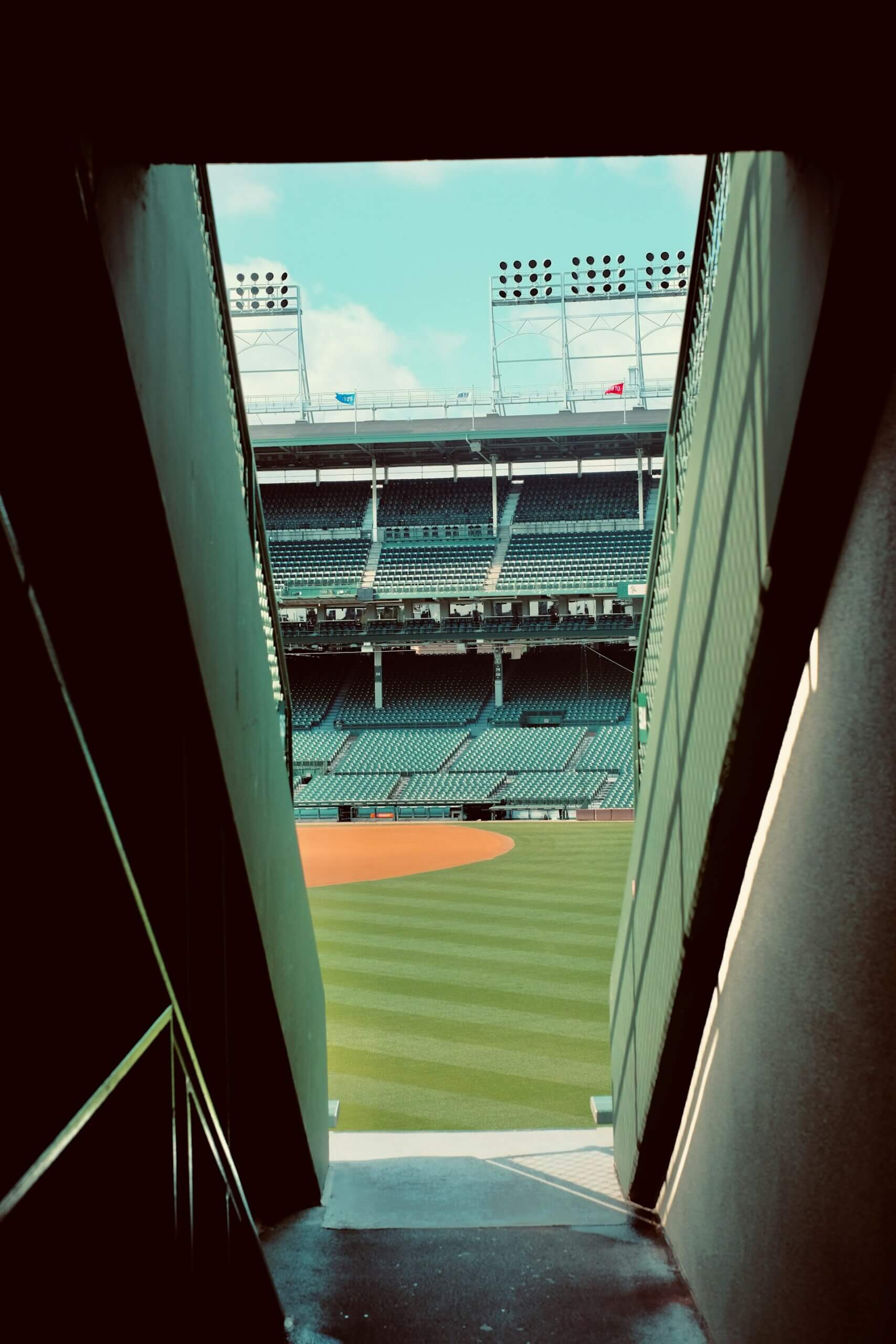
Photo by Daniel Ziegener on Unsplash