
The Great Chicago Fire of 1871 swept through the city and erased most of what stood in its path. That is why the oldest buildings in Chicago feel so precious today. A handful of structures slipped through, were moved to safety, or rose just after the flames.
This guide covers the best of them, with street addresses and visiting notes. If you want to cap a day of exploring with deep-dish, our Lincoln Park restaurant is the perfect finish. For more on what makes Chicago so special, keep reading.
Oldest Buildings in Chicago: A Journey Through the City’s Surviving Architectural Heritage
This list moves through architectural periods rather than ranking the buildings strictly. Early homes and nineteenth-century public works sit alongside postfire commercial towers, and each tells a different part of the story.
“Oldest” needs careful handling. The Clarke-Ford House is the city’s oldest house. Some homes within today’s city limits predate 1836, but they stood outside Chicago when they were built, so the Clarke-Ford House holds the title only for houses. Old St. Patrick’s Church is described as the city’s oldest public building. In the area the 1871 fire destroyed, only the Chicago Water Tower and the Chicago Avenue Pumping Station among public buildings survived. Founding dates can mislead, too, since a congregation or institution is often older than its current building. We date each structure by its surviving walls.
Why So Few Early Structures Remain: Fire, Rebuilding, and Relocation
The 1871 fire destroyed most buildings on the Near North Side. Rebuilding came fast, and fire-resistant housing went up across the area. Almost all of the earliest row houses were lost, either to the fire or to later redevelopment.
Fire was only part of the story. Location and changing development patterns mattered, as did relocation and preservation work. Some survivors simply sat out of the fire’s path.
Clarke-Ford House (Henry B. Clarke House): An 1836 Survivor on S. Indiana Ave.
This is the oldest house in Chicago, and it’s one of the city’s key historic sites. It was built in 1836 for Henry B. Clarke, and it reflects family life before the Civil War, when the surrounding area was largely prairie.
History, Relocation, and Key Architectural Features
The Henry B. Clarke House took its current name in 2022. The Clarke-Ford name recognizes Caroline Palmer Clarke and Bishop Louis Henry and Margaret Ford. After Henry Clarke died, his widow, known as the “Widow Clarke,” developed family land in the 1850s. That grew the neighborhood and helped fund unfinished parts of the house.
The house has moved twice and survived a fire. The Fords and the St. Paul Church of God in Christ congregation worked to preserve it between 1941 and 1970. It became an early local landmark in 1970, and the National Society of Colonial Dames in The State of Illinois has been involved since 1977. Its move to the current site involved hoisting it over elevated train tracks. Restorers returned it to its 1860s appearance, and paint research meant removing as many as 27 layers.
Visiting Tips and Location Details
The house sits at 1827 S. Indiana Ave. inside Chicago Women’s Park and Gardens, part of the Prairie Avenue Historic District. The park is at 1801 S. Indiana Ave., between the Clarke House and Glessner House, and it opened in 2000. You’ll find a community garden and an ornamental fountain on the grounds, plus the “Helping Hands” sculpture that honors Jane Addams.
Tours are temporarily paused while the City reimagines public programming, so plan on enjoying the grounds and the surrounding district. The house has an accessible elevator. Check the City’s official channels for current access before you go.
Chicago Water Tower: The Landmark That Survived the 1871 Fire
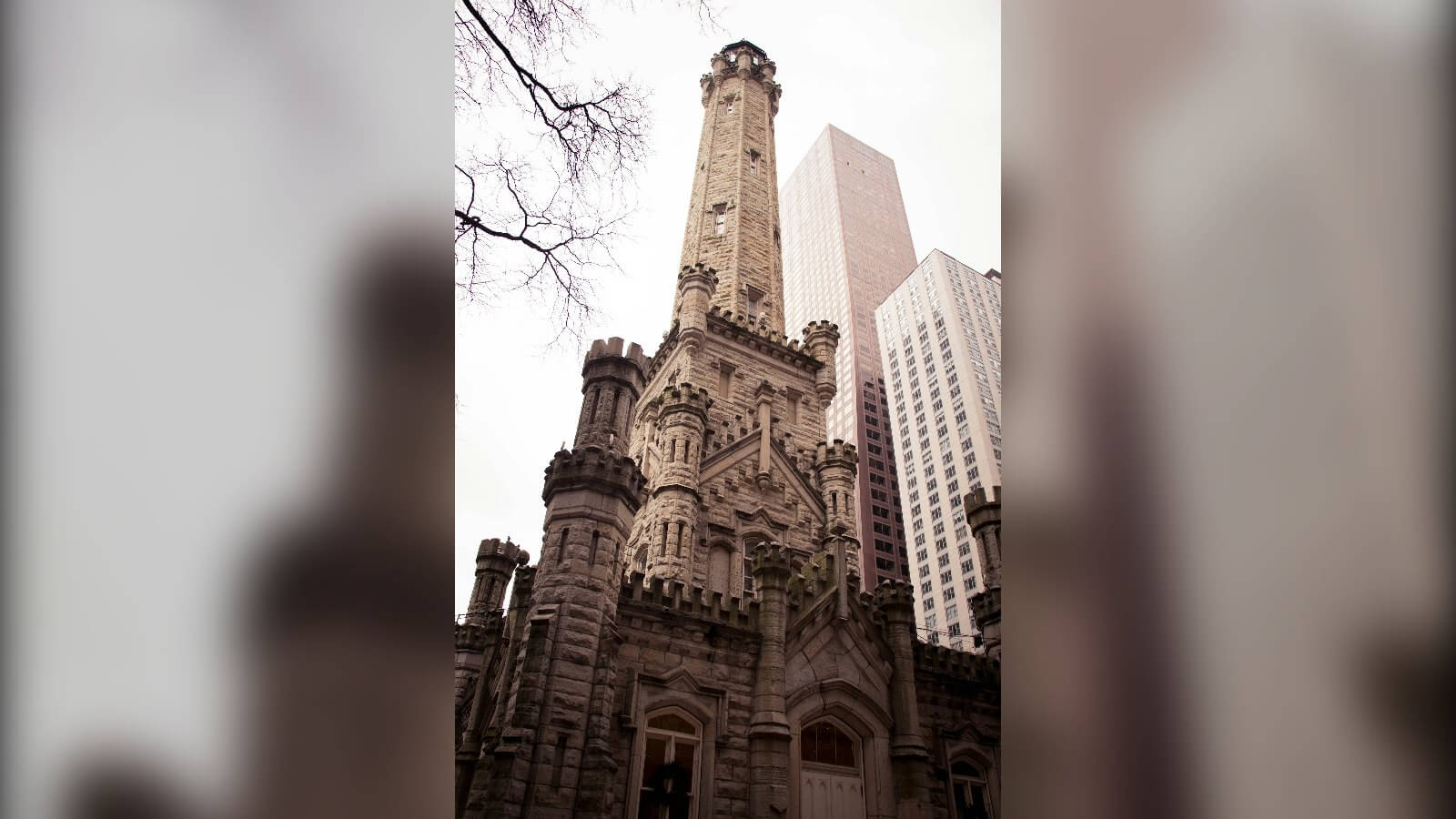
The Chicago Water Tower is among the most famous buildings to visit in the city, and its survival is the reason. It started as working infrastructure, built to house a 138-foot standpipe. That standpipe was removed in 1911 after it became obsolete. Standing amid the glass and steel of Michigan Avenue, the tower makes Chicago’s changing scale easy to see.
Gothic Revival Design and Historical Significance
The tower and the neighboring Chicago Avenue Pumping Station share a castellated Gothic Revival style. The tower is a fanciful interpretation of a medieval fortress. Both buildings came through the fire and remain rare monuments to the nineteenth century.
Where to Find It and What to See Nearby
The Old Chicago Water Tower District sits at Michigan and Chicago Avenues on the Near North Side. It was designated a Chicago Landmark on October 6, 1971. The district includes the Water Tower, the pumping station, a turn-of-the-century fire station, and two small parks. The City Gallery is in the Water Tower.
Enjoy the exterior freely, and check official visitor information before planning to go inside. A Michigan Avenue stroll pairs well with this stop. The City’s Boul Mich tour covers a two-mile stretch between Lake Michigan and Roosevelt Road. Landmarks along it include the Auditorium Building, Michigan Avenue Bridge and Esplanade, and Tribune Tower.
The Rookery Building (1885-1888): A Landmark at 209 S. LaSalle St.
The Rookery is not among the very oldest survivors. Its importance comes from the postfire period, when rebuilding supported multi-story office buildings. It shows how architects moved from heavy masonry toward tall commercial construction. For more on famous skyscrapers in Chicago, see our companion guide.
Architecture, Design Highlights, and the Famous Light Court
Burnham & Root, meaning Daniel Burnham and John Wellborn Root, built the Rookery from 1885 to 1888. It is a transitional structure that pairs load-bearing masonry exterior walls with skeletal-frame construction. At eleven stories, it was one of the world’s tallest buildings when completed. Root’s “floating foundation” of iron rails and beams encased in concrete holds it up on soft clay.
The name comes from a temporary City Hall and water tank on the site after the fire, where pigeons roosted. Look for the Romanesque entrance arch on LaSalle Street, with carved rooks.
The Light Court draws the most attention. Frank Lloyd Wright remodeled the lobby, with work recorded from 1905 to 1907. His redesign added white marble with gold geometric patterning that covered Root’s copper-plated ironwork. Root’s oriel staircase winds from the 12th floor to the 2nd, and the atrium’s white-glazed brick walls reflect light inward. The court has an iron frame and a glass-block mezzanine, all finished with hand-laid mosaic tile. A skylight was installed in 1992.
Visiting the Loop’s Historic Skyscraper
The Rookery stands at 209 S. LaSalle St. and was designated a Chicago Landmark on July 5, 1972. The first-floor Light Court lobby is open to the public Monday through Friday from 7 a.m. to 6 p.m. and Saturday from 8 a.m. to 2 p.m. It is closed Sundays. Enter through the Adams Street door.
Handheld camera or phone photography is permitted, but tripods are not. The Frank Lloyd Wright Trust runs tours Monday through Friday. This is a working office building, so check the official channels for current hours and tour details before you go.
Other Historic Chicago Buildings Worth Exploring
Old St. Patrick’s Church in the West Loop was founded in 1846 as Chicago’s first English-speaking Catholic church. The current brick building, completed in 1856, was designed in the Romanesque style by Augustus Bauer and Asher Carter and dedicated on Christmas Day 1856. The fire missed it by two blocks. Thomas A. O’Shaughnessy’s 15 stained-glass windows (1912 to 1922) draw on Book of Kells designs. It is an active church, so respect services when you visit.
Erie Street Row, at 161 E. Erie St., is three Italianate rowhouses built around 1877 with a Joliet limestone facade. Kenwood United Church of Christ, at 4600-08 S. Greenwood Ave., is a Richardsonian Romanesque Chicago Landmark built in 1887 and 1888. William W. Boyington designed it with Harry B. Wheelock. Glessner House, near the Clarke-Ford House, rounds out the Prairie Avenue stops.
Need a break? Many of our guests make Pequod’s Pizza their fuel-up stop between neighborhoods, and you can order online for carryout or delivery.
Plan Your Historic Architecture Tour: Itinerary and Practical Tips
Group your stops by area, since construction date makes a poor route. Visiting every site in one day isn’t realistic, so pick a few and leave time for travel. This table lists the main stops.
| Building | Year | Location | Area |
|---|---|---|---|
| Clarke-Ford House | 1836 | 1827 S. Indiana Ave. | Prairie Avenue Historic District |
| Old St. Patrick’s Church | 1856 (building completed) | West Loop | West Loop |
| Chicago Water Tower | Survived the 1871 fire | Michigan and Chicago Avenues | Near North Side |
| The Rookery | 1885–1888 | 209 S. LaSalle St. | Loop |
Start in the South Loop and Prairie Avenue area, with the grounds of the Clarke-Ford House and Chicago Women’s Park and Gardens. From there, head to the Loop and see the Rookery’s Light Court. The Near North Side makes a good last stop, where the Water Tower and a Michigan Avenue stroll wrap things up. Old St. Patrick’s in the West Loop fits between stops if time allows.
Take the CTA or a rideshare between clusters, and check the CTA’s trip planner before you go. Plan for weather and mobility needs. Confirm hours, tour schedules, and any closures shortly before you travel, since historic status does not guarantee public entry. The Chicago Architecture Center is a good official source for tour options.
After the Tour, Enjoy Deep-Dish at Pequod’s Pizza in Lincoln Park
Lincoln Park is a separate trip from the downtown and South Loop stops, so allow extra travel time. We’d suggest a relaxed meal with no tight schedule.
-
Pequod’s Pizza is a historic, award-winning Chicago restaurant specializing in deep-dish with a caramelized cheese crust. We press mozzarella against the pan until it turns golden and slightly charred. Burt Katz founded us in 1971 in Morton Grove, and our Lincoln Park location opened in 1992. Learn more about us.
-
Bon Appétit has highlighted Pequod’s as one of the finest versions of Chicago-style deep dish, and we earned the No. 1 spot on USA TODAY 10Best’s “Best Pizza in Chicago” list. In 2024, Yelp ranked us the No. 1 pizza spot in America, and fans of FX’s The Bear may recognize us from season two’s “Forks” episode (2023).
-
Find us at 2207 N. Clybourn Ave. in Lincoln Park (773-327-1512), open Monday through Saturday from 11 a.m. to 2 a.m. and Sunday from 11 a.m. to midnight, so even a late finish to your tour day works. Tables fill up fast, so we recommend reserving ahead, or skip the wait with carryout or delivery through our online ordering.
Coming from the northern suburbs? Our Morton Grove original is waiting. Whichever you choose, come hungry after all that history.